
Thrasio, one of the largest Amazon brand aggregators, uses data science to learn why products earn great ratings, reviews and rankings. For its AngryOrange brand, our brief was to take any business problem and turn it into a data problem.
The challenge
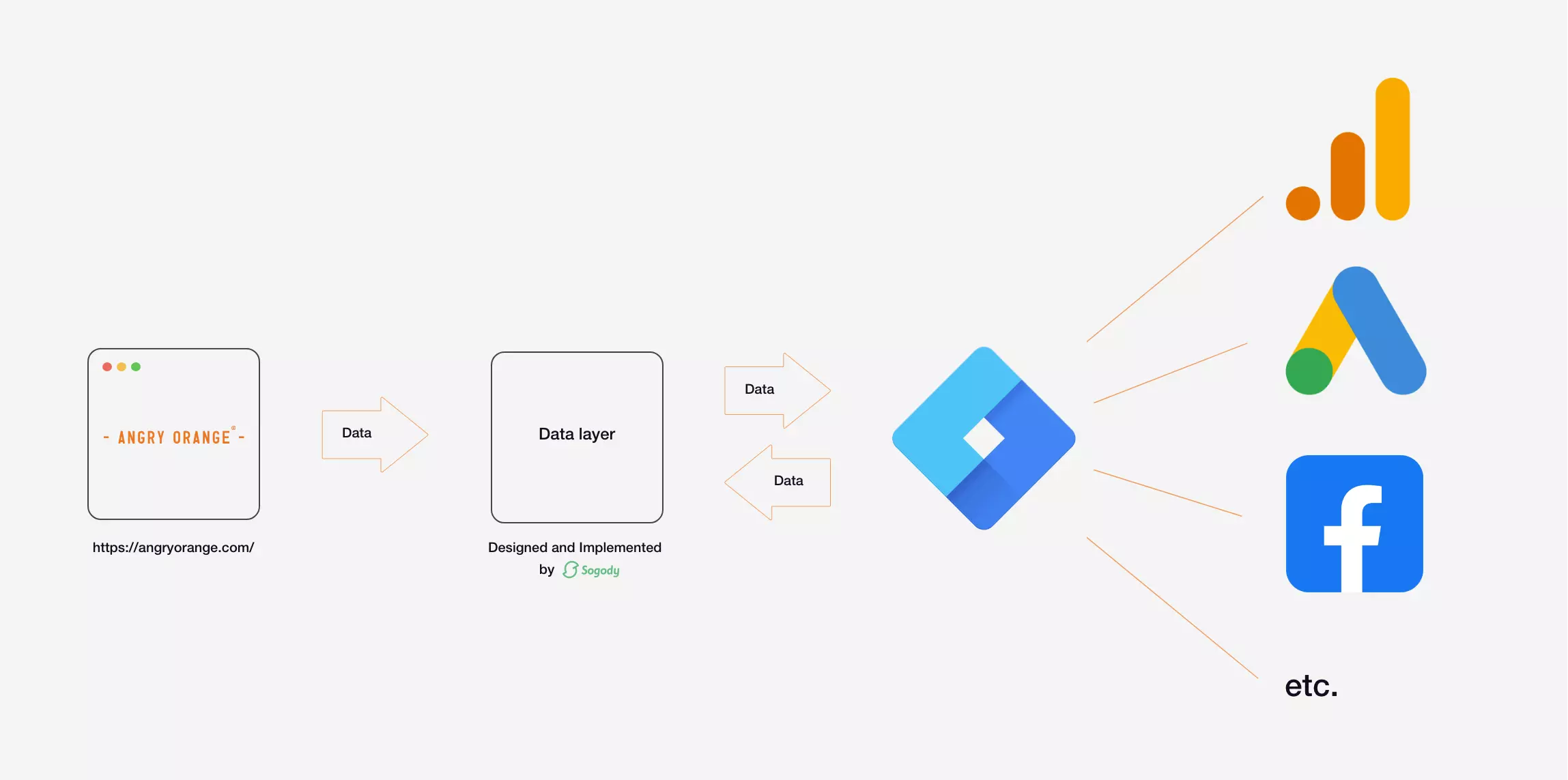
Data flowed from AngryOrange's site into many third-party tools: analytics, ads and social. Each needed the same, reliable picture of what visitors did.
That needed one point that captures every event in a visitor's journey once. A tag manager then reads it and fires each tool's tags, so they all get the same data.
Designing the data layer
We chose an event-driven design: events push into the layer the moment they happen. Each carries three standard fields that map straight into tools like Google Analytics.
Event names the type, such as a click. Event Category groups it by site section, such as product or listing pages. Event Label says what happened, such as "Add to cart". Harder cases add custom detail, like the products and quantity added.
Mapping every event
We went through every page in detail to cover every interaction: navigation, social links, pop-ups, filled forms and more.
We added events only this brand needed, such as a visitor viewing an out-of-stock product.
Building it in
Clickable elements carry data attributes that describe the event. Elsewhere, client-side scripts fill the layer as events occur, and Shopify's own events are intercepted and mapped to the same structure.
Capture each event once, and every tool tells the same story.
- Each tool tracking on its own→One layer feeding every tool
- Shopify events in their own shape→Mapped to one structure
- Generic tracking→Events specific to the brand
Results
- Data consistent across every third-party tool.
- Granular control over AngryOrange's site data.
- Standard fields that map straight into Google Analytics.
- Custom events, such as out-of-stock views, for questions specific to the brand.
- Shopify events captured in the same structure as everything else.


